
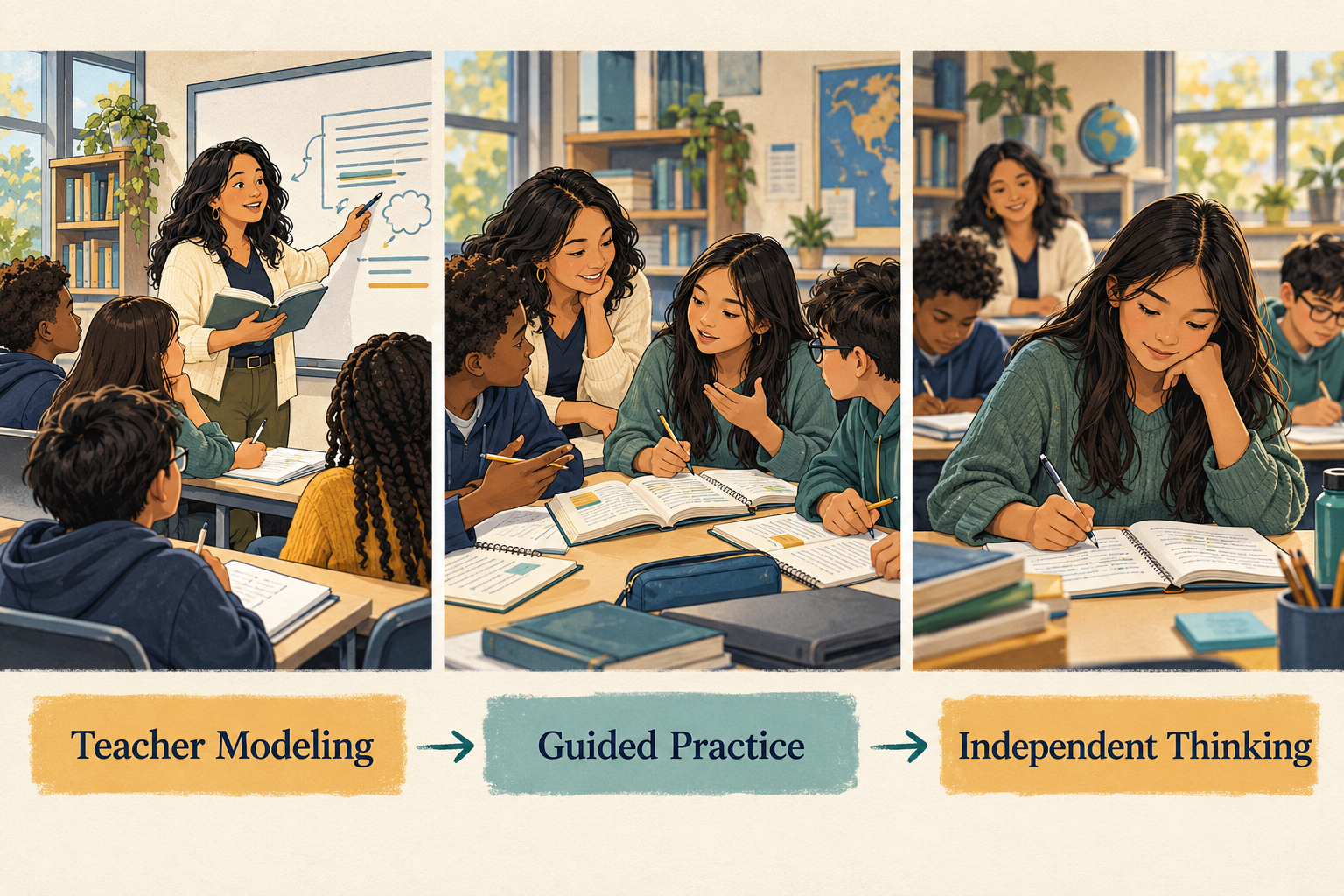
How much should teachers explain, and how much should students figure out on their own?
It’s a question worth asking. We want students thinking, participating, and taking ownership of their learning. We also want them to have the knowledge and skills to do that successfully.
Sometimes, that means a teacher needs to slow down and explain something clearly. Other times, it means stepping back and giving students room to work through a challenge. The important part is knowing what students need and when they’re ready for more responsibility.
Students need something to work with
Think about learning something unfamiliar. It helps to see someone do it, hear how they make decisions, and get a chance to practice with feedback.
Students benefit from that same support.
When I use the term direct instruction here, I’m talking about clear explanations, modeling, and guided practice. A teacher might work through an example, explain a decision out loud, or pause to check whether students understand before moving forward.
Rosenshine’s research synthesis brings these practices together with independent practice. Clear teaching and opportunities to work independently are connected parts of instruction. Read Principles of Instruction.
If we ask students to analyze evidence before they understand what makes evidence useful, some will know where to start. Others may spend their time trying to guess what we want.
A clear model can give more students a way into the work.
What does taking ownership actually look like?
We often talk about giving students choices. That can be helpful, but choosing a partner or deciding between a poster and a slideshow only tells us so much.
I’d also want to know: Can students explain why they chose a particular strategy? Can they recognize when something isn’t working? Do they know when to ask for help and how to use feedback?
Those decisions matter. The OECD’s Learning Compass describes agency in terms of students influencing their learning, setting goals, and acting responsibly. Explore the OECD Learning Compass.
Students can practice those habits even while they still need support. During a teacher’s demonstration, they can point out a confusing step, ask for another example, or explain where their own thinking went in a different direction.
Here’s what that might look like in a lesson
Imagine a seventh-grade ELA class writing about a character’s decision.
The teacher starts by modeling how to support a claim with evidence. Instead of simply showing the correct answer, the teacher compares two quotations and talks through why one offers stronger support.
Then students try it together. They compare another set of quotations, explain their choices, and hear how classmates approached the same question. The teacher listens and addresses misunderstandings.
Now students are ready to develop their own claims. They choose evidence, explain their reasoning, and decide what needs revision.
Some may need a sentence starter or a quick conference. Others may be ready to consider a counterargument. Everyone is working toward the same learning goal, with support adjusted along the way.
There’s room for clear teaching and meaningful student decisions throughout that lesson.
What should school leaders pay attention to?
When we walk into a classroom, we’re seeing a small part of a much longer learning process.
A teacher explaining something may be giving students exactly the support they need. Students working quietly on their own may be making thoughtful decisions, or they may be stuck. We need more information before deciding how well the lesson is working.
A few useful questions are:
- What are students learning to do?
- How is the teacher checking their understanding?
- What decisions are students making for themselves?
- What shows they’re ready for more independence?
Those questions give us a better starting point for feedback than simply counting how much the teacher talks.
The goal is for students to become more capable and confident learners. Getting there takes clear instruction, practice, feedback, and chances to make decisions that matter.
For your next lesson, consider one question: Where do students need a little more guidance, and where are they ready for you to step back?