

For years, classroom behavior has been framed as a classroom-level issue. A student disrupts instruction, refuses to work, talks over the teacher, leaves their seat, shuts down, or escalates. The teacher is expected to redirect, document, call home, repair the relationship, adjust the lesson, continue instruction, and keep every other student moving forward.
That is a lot to carry in one moment.
Recent reporting from Education Week, drawing on RAND's 2026 State of the American Teacher data, shows that student behavior is one of the most common sources of teacher job stress. RAND's 2026 findings also show that about half of teachers ranked managing student behavior as a top source of job-related stress. For early-career teachers, the number was even higher.
School leaders should pause there.
When behavior becomes the daily barrier to instruction, it affects more than classroom climate. It affects teacher confidence, instructional quality, student learning, and whether teachers believe they can keep doing the work.
I have seen teachers who deeply love students begin to question their future in education. Not because they lost their purpose. Not because they stopped believing in children. Because they felt alone in the weight of the work.
Teachers are not asking for perfect classrooms. They are asking for systems that make teaching possible.
The Behavior Retention Framework
When behavior begins to affect teacher retention, school leaders need a clear way to look at the problem. I use five questions to move the conversation away from blame and toward action.
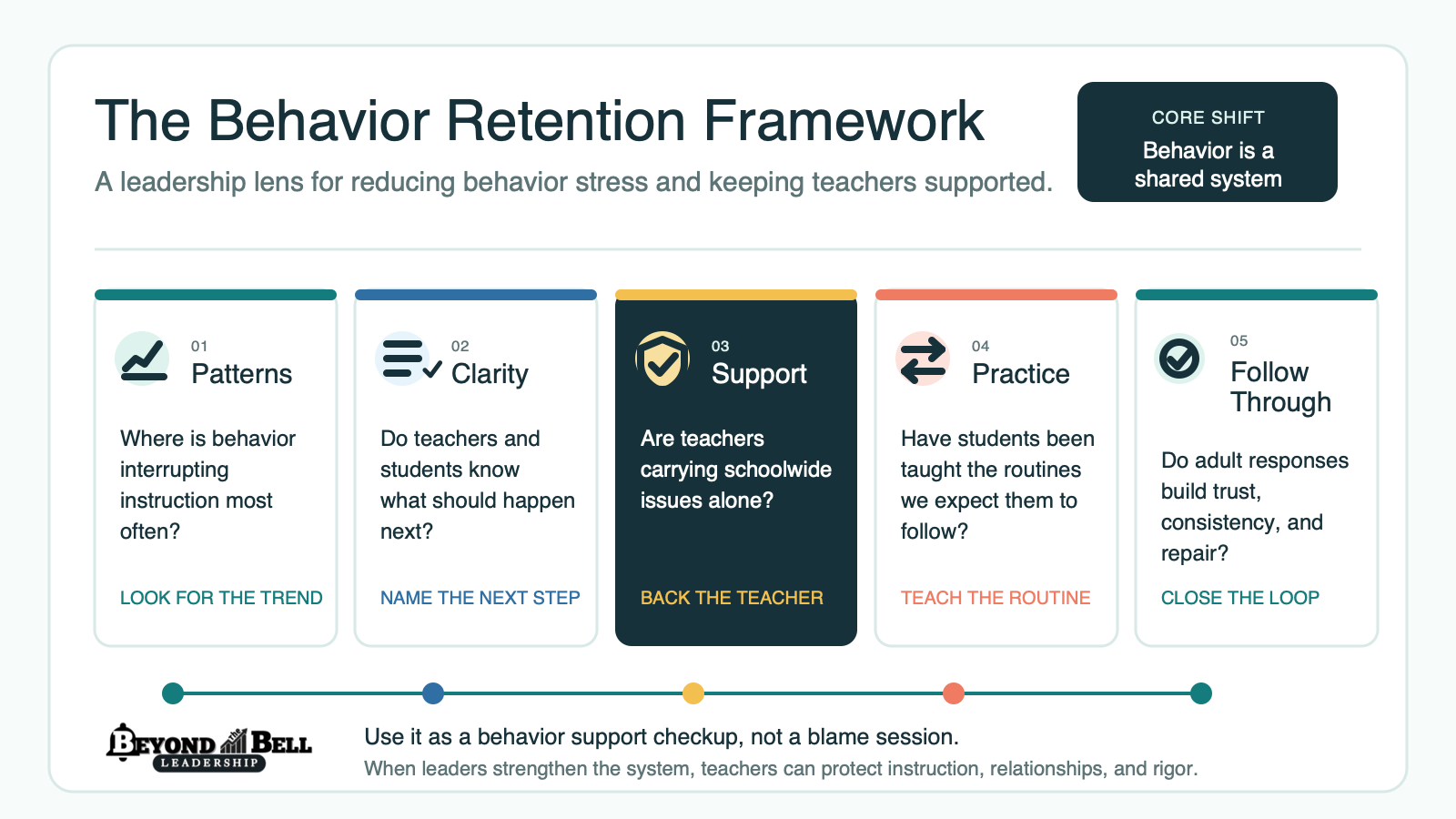
1. Look for Patterns Before Blaming People
A data-driven school does not only track test scores. It studies the conditions that make learning possible.
Behavior data can include referrals, attendance trends, classroom walkthrough notes, student surveys, teacher feedback, and the times of day when disruptions increase. The goal is not to label students or judge teachers. The goal is to understand where the system needs attention.
If most behavior issues happen during transitions, the school may need stronger transition routines. If referrals spike after lunch, the team may need to study supervision, reentry, and classroom reset practices. If new teachers are reporting the most stress, they may need coaching, modeling, and faster support.
Patterns help leaders stop guessing.
2. Make Expectations Clear for Adults and Students
A strong behavior system does not begin with a consequence chart. It begins with clarity.
What are the schoolwide expectations? Which routines should students experience in every classroom? What behaviors should teachers handle first? What behaviors require administrator support? What happens after a referral? How does a student return to class after conflict?
If those answers are unclear, teachers will create their own systems out of necessity. Some will become stricter than they want to be. Some will become more flexible than the school can sustain. Some will document everything. Some will stop documenting because they do not believe anything will happen.
That is usually not a sign that teachers do not care. It is often a sign that the system is not clear enough to support them.
3. Stop Making Teachers Carry Schoolwide Problems Alone
A teacher can handle a hard day. A teacher can handle a challenging student. A teacher can reteach expectations, repair relationships, and adjust instruction.
What wears teachers down is the feeling that every behavior concern lands back on them without a larger plan.
School leaders do not need to remove every challenge from the classroom. That is not realistic. But leaders do need to create conditions where teachers know they are backed by a consistent system.
Support might look like a quick administrator response, a restorative reentry process, coaching after repeated disruptions, a family communication plan, or protected time for teams to review behavior patterns together.
The message to teachers should be clear: You are not alone in this classroom.
4. Teach Behavior Like We Teach Instruction
Behavior is part of instruction.
Students need to learn how to participate in a learning community. They need routines, modeling, practice, feedback, and repair. They need adults who are consistent, calm, and aligned.
Teachers also need practical professional learning. Not broad reminders to build relationships, but specific tools they can use tomorrow.
How do I reset a class after disruption? How do I give a calm correction? How do I teach a routine explicitly? How do I avoid a public power struggle? How do I restore a student after conflict? How do I maintain rigor without escalating stress?
Professional learning should be student-centered and teacher-oriented. Students need support, and teachers need tools that work in real classrooms.
5. Protect Rigor by Protecting the Teacher
Rigor does not survive in chaos.
If a teacher spends most of the period redirecting behavior, documenting incidents, and trying to regain attention, the lesson suffers. The teacher knows it. The students know it too.
This is why behavior support belongs in conversations about instructional growth. We cannot talk about higher-level questioning, student discourse, writing quality, or academic ownership if the classroom conditions do not allow teachers to teach.
Supporting behavior is not lowering expectations. It is how we protect expectations.
A Behavior Support Checkup
For school leaders, the next step is a behavior support checkup.
- Where are teachers losing the most instructional time?
- Where are students receiving inconsistent expectations?
- Where are administrators sending mixed messages?
- Where do teachers need coaching instead of criticism?
- Where do students need stronger routines instead of stronger punishment?
- Where is the system asking individual teachers to solve schoolwide problems alone?
Classroom behavior is now a teacher retention issue because it sits at the intersection of everything teachers are being asked to do: raise achievement, support mental health, build relationships, maintain rigor, communicate with families, document concerns, and stay emotionally regulated through it all.
If we want teachers to remain mission focused, we have to build schools that are mission supportive.
Teachers are not asking for easy work. They are asking for work that feels possible.
When school leaders treat behavior as a shared instructional priority, they send a message teachers need to hear:
You are not carrying this by yourself. We are building the conditions for teaching and learning together.